To try and help folks understand automation in a bit more depth we are going to look at a single point with a bit of depth. Rather than just shotgun 30 different things at you lets go a bit further with one point. This time it is going to be material flow.
Material flow is what it sounds like. Its pacing raw material arrival all the way to having pallets or boxes to send out finished product. With good material flow you have removed most of the pinch points to getting product out the door.
How do you identify poor material flow? It can be as simple as looking around. Stacks of steel that need to have the rust knocked off before you can use them might be a sign for some but normal for others. Piles of blanks waiting to be bent could be a sign as would a like pile that were welded but are waiting to be ground. It will be different depending on a good deal of variables.
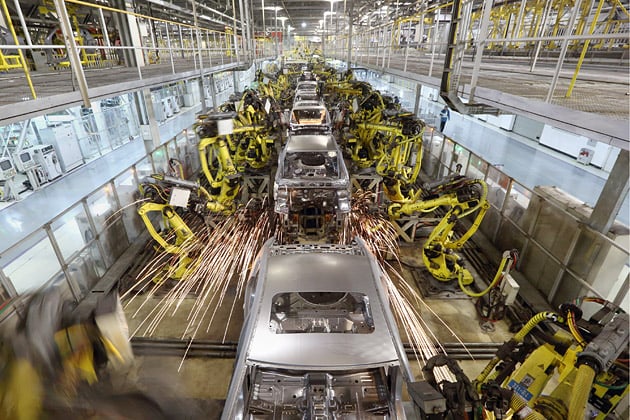
What you want is to limit the raw material to what you need to produce. But to do that you need to be efficient in production. This often becomes an issue when one process is made to be very efficient vs the rest of the operation. It can also happen when one operation falls behind the rest. We all like to call it a bottleneck these days. A bottleneck happens when an efficient process feeds into an inefficient one. An example that has become more common is automated welding operations. You suddenly find that the welding has a much higher throughput and fewer rejections. But the issue is that the steps before and after the welding have not changed. Are you in a position to feed the welding operation more material? Do you have the capacity downstream of the welding to finish or paint the items? You improve the welding and make it more efficient but by not having the capacity to take full advantage you just moved the bottleneck to another point.
This is material flow, the operations should pace each other as best as possible. If it takes 45 min to cut a part and 5 min to bend it there is an issue. Same general idea applies to each process you have in an overall operation. You don't want to have piles of cut parts sitting around waiting to be formed. Material flow is keeping the part moving through the process as efficiently as possible. It is common to run a modern laser lights out these days. Now when first shift starts there are plenty of cut parts to form and send through production. That would be an example of managing material flow. At the same time installing 10 monster lasers is not going to net you 10x the product per day. Every link in the chain would need the 10x treatment down to having 10x the boxes or pallets.
When you look at a bottleneck don't forget to look at the other links in the chain around that point. Keep the material moving, adding to each of the slowest steps a bit may net you a larger gain than a single huge investment in one link of the chain. Good material flow can be a good sign of a healthy operation. It may not be as fast as you want but its healthy and receptive to speed improvements and automation.
Topics metal finishingautomotiveAutomationRobotics